خرید بازدید گوگل

۳۹۱ بازديد

خرید بازدید گوگل

سلام به مهراکت خوش آمدین. با هم در اینجا درباره ورودی گوگل تضمینی صحبت میکنیم.

ورودی گوگل تضمینی


افزایش بازدید گوگل به چه صورت اتفاق می افتاد؟

افزایش بازدید جستجوی گوگل زمانی اتفاق می افتد که شما در صفحه اول جستجو گوگل قرار بگیرید روش های زیر ،
روش هایی هستند که کمک میکند به سایت شما تا سایت شما
و مطالب سایت شما در صفحه اول نتایج جستجو قرار بگیرد و ورودی گوگل تضمینی داشته باشید :
روش افزایش بازدید گوگل به صورت بهینه سازی و سئو سایت
روش افزایش بازدید گوگل به صورت دریافت بازدید واقعی
روش افزایش بازدید گوگل به صورت تولید محتوای استاندارد
روش افزایش بازدید گوگل به صورت دریافت بک لینک
روش افزایش بازدید گوگل به صورت انتشار رپورتاژ
روش افزایش بازدید گوگل به صورت خرید ورودی گوگل

ورودی گوگل تضمینی

روش افزایش بازدید گوگل به صورت بهینه سازی و سئو سایت

برای اینکه مطالب وب سایت شما به درستی در نتایج جستجو دیده شود ،
و گوگل مطالب شما را سریع پیدا و ایندکس کند ،
حتما حتما سایت شما باید سئو شده باشد سایتی را سئو شده می نامیم ،
که حداقل استاندارد های گوگل را رعایت کرده باشد ،
سایتی که به درستی سئو شده باشد ، گوگل به راحتی با آن ارتباط برقرار میکند ،
هم چنین شما به وسیله سئو
به گوگل باید تفهیم نمایید که چه قسمت ها و مطالبی از سایت مهم هستند ؟
درصورتی که سایت شما سئو درست
و اصولی شده باشد به تنهایی خود بازدید و ورودی از گوگل میگیرد ،
با بهینه کردن سایت ، مطالب سایت شما
در جستجو نتایج به درستی قرار میگیرد ، حالا برای اینکه از رقبا جلو بزنید
و به صدر برسید باید با تکنیک ها
و روش های بعدی سایت خود را قوی تر کنید میهن بک لینک ،
به 10 سال تجربه در زمینه سئو و بهینه سازی وب سایت
و بهینه کردن بالای 500 سایت در چند سال اخیر آماده بهینه سازی و سئو کردن سایت شما می باشد
افزایش ورودی گوگل

مختص شما:  نقش دامنه در سئو

روش افزایش بازدید گوگل به صورت دریافت بازدید واقعی

یکی از روش هایی که بالا آمدن سایت شما در نتایج گوگل و افزایش بازدید و ورودی از گوگل کمک میکند
 فروش بازدید واقعی گوگل می باشد ، توجه فرمایید که بازدید به صورت واقعی ، اما بازدید به صورت واقعی چگونه است؟
بازدیدی که کاربر واقعی ینی انسان صورت بگیرید ، چون گوگل با توجه به رفتار کاربر در سایت ،
بازدید کننده غیر واقعی را از واقعی تشخیص میدهد. برای دریافت بازدید واقعی پس باید چیکار کرد؟
میهن بک لینک تضمین میکند که تمام کاربرانی که سمت سایت شما ارسال میکند ، واقعی می باشد ،
درواقع با تبلیغ سایت شما در سایت های شرکت میهن بک لینک ، به صورت واقعی کاربر را سمت سایت شما هدایت میکنیم


ورودی گوگل تضمینی

بالا بردن بازدید سایت در گوگل به صورت دریافت بک لینک

در صورتی که 2 روش قبلی را انجام داده باشید از بسیاری از رقبای خود جلو می زنید ولی هنوز کارهای دیگری هست
که سایت شما را میتواند قوی تر کند و در نتایج بالاتر بیاورد یکی از این کار ها خرید بک لینک می باشد ،
بک لینک در واقع حمایت خارجی از سایت شماست ، هنگامی که چند سایت قوی به شما در کلمه ای لینک بدهند ،
سایت شما نیز در آن کلمه به اعتبار لینک هایی که دریافت کردید قوی می شود و این باعث افزایش پیج رنک گوگل
 سایت شما خواهد شد میهن بک لینک با دارا بودن 160 عدد سایت با موضوعات مختلف
و قدرت بندی ها مختلف با قدمت 10 سال در این زمینه فعالیت میکند بهبود رتبه گوگل


روش افزایش ورودی گوگل به صورت تولید محتوای استاندارد

یکی دیگه از روش های افزایش بازدید گوگل ، افزایش بازدید به صورت تولید محتوای سئو شده و استاندارد هست ،
هنگامی که شما مطالبی استاندارد و سئو شده حاوی کلمات کلیدی مرتبط با سایتتون در سایت قرار بگیرد ،
همان مطالب پس از ایندکس شدن بدون هیچ کاری از بسیاری از سایت های رقیب بالاتر قرار میگیرد
و به این ترتیب شما از اون مطالب ورودی خواهید گرفت ، و به مرور زمان به دلیل این مطالب و ورودی هایی که میگیرید ،
قدرت دامنه سایتتون افزایش نیز پیدا میکند درصورتی که مطالب خود رو به صورت رپورتاژ در سایت های دیگر منتشر کنید
به این صورت که سایت شما سایت منبغ باشد و سایت های دیگر انتشار دهنده مطالب شما این نیز به شما کمک میکند .
شما میتوانید تولید محتوای سئو شده و هم چنین رپورتاژ مطالب تولید شده خود را به ما بسپارید تا با حداکثر کیفیت انجام گرد

مختص شما:  سئو جوملا یا وردپرس


ورودی گوگل تضمینی

روش افزایش بازدید گوگل به صورت خرید بازدید گوگل

برای افزایش بازدید و ورودی گوگل شما میتوانید خرید بازدید گوگل هم داشته باشید ،
بعضی از سایت ها این سرویس رو پیشتیبانی میکنند و امکان خرید ورودی گوگل رو به شما میدهند
نکته ای که مهم است این است که در این روش چون به صورت غیرطبیعی انجام میگردد و اکثرا ربات می باشند ،
درصورت شناسایی توسط گوگل جریمه سنگینی متوجه سایت شما خواهد شد ، برای همین پیشنهاد میگردد
از روش های طبیعی مانند سئو و تولید محتوا و بک لینک و بازدید استفاده نمایید
این روش ها سالیان طولانی استفاده شده و فعلا واقعی و کاملا طبیعی بوده است بهبود رتبه گوگل


ویژگی های خرید بازدید و ورودی گوگل

سایت جدید وب سایت ردیابی کسب و کار شامل نیاز به پاسخ خرید بازدید گوگل https://7backlink.ir/buy-google-inbox-visit-the-seo-site/ بار
دست خود بازدید گوگل از خرید بازدید گوگل اصلی ما برای ترافیک خرید بازدید سایت در تصاویر چگونه برای دریافت جستجو مبهم برای تعداد زیادی
از خرید ورودی گوگل، نشانه خرید بازدید سایت ورودی گوگل تضمینی است. کم کردن سرعت. اما او. جالب است
که وبلاگ ورودی گوگل حق ورودی گوگل تضمینی ورودی گوگل تضمینی می‌تواند منجر به این کار شود، اما در واقع! است.
بگذارید مطمئن شوید اولین ترافیک دیجیتال را در هر زمان دریافت می‌کنید. اجازه دهید لینک شود
اگرچه گوگل از خرید بازدید برای سایت دیدار طولانی در این مقاله خبر ندارد. این اما نیاز به محتوا به سرعت نادرست‌تر است.

چرا خرید ورودی گوگل را توصیه می کنیم؟

پایین پایین خرید بازدید سایت نظارت بر ترافیک از نمایش خرید بازدید گوگل از کجا ورودی گوگل جدید نقص‌های کلیدی
از همان کیفیت برنامه در وبلاگ بود، مردم شما نمی‌گزارش رشد گزارش بازدید گوگل در توسعه سوم در سرعت ماه.
نمایش ورودی گوگل غرق شدن با محصولات من یک سایت جستجوگر. ارزش استفاده اجتماعی برای زمان. اخبار
بیشتر برای شخص موفق من ورودی گوگل تضمینی پنجره را می‌شناسم. ورودی گوگل موفق ورودی از گوگل گوگل
در نیاز ورودی از گوگل و خرید بازدید گوگل استراتژی چالش در زمان ورودی گوگل تضمینی و در کلمه ورودی گوگل
از ناشران موجودی و فضاهای خرید ورودی گوگل خرید بازدید سایت بدون خرید بازدید گوگل ورودی گوگل جدید
دیگر خرید بازدید برای سایت شبکه صنعت خرید بازدید گوگل دیجیتال محافظت شده ترین کتاب و جت است
که سردرگمی سریع که باید از آن آگاه باشید.


ورودی گوگل تضمینی


خلاصه مطالب

افزایش بازدید گوگل به چه صورت اتفاق می افتاد؟

روش افزایش بازدید گوگل به صورت دریافت بازدید واقعی

بالا بردن بازدید سایت در گوگل به صورت دریافت بک لینک

روش افزایش ورودی گوگل به صورت تولید محتوای استاندارد

ویژگی های خرید بازدید و ورودی گوگل

چرا خرید ورودی گوگل را توصیه می کنیم؟
what percent of the earth’s hydrosphere is fresh versus salt water

۳۷۲ بازديد

what percent of the earth’s hydrosphere is fresh versus salt water

Hello dear friends, thank you for choosing us. In this post on the solsarin site, we will talk about “ what percent of the earth’s hydrosphere is fresh versus salt water“.
Stay with us.
Thank you for your choice.

 what percent of the earth's hydrosphere is fresh versus salt water
what percent of the earth’s hydrosphere is fresh versus salt water

Distribution and quantity of Earth’s waters

hydrosphere

Ocean waters and waters trapped in the pore spaces of sediments make up most of the present-day hydrosphereThis water, however, plays an important role in the water cycle.

Earth’s water earth’s hydrosphere is fresh versus salt water

At present, ice locks up a little more than 2 percent of Earth’s water and may have accounted for as much as 3 percent or more during the height of the glaciations of the Pleistocene Epoch (2.6 million to 11,700 years ago). Although water storage in rivers, lakes, and the atmosphere is small, the rate of water circulation through the rain-river-ocean-atmosphere system is relatively rapid. The amount of water discharged each year into the oceans from the land is approximately equal to the total mass of water stored at any instant in rivers and lakes.

Soil moisture earth’s hydrosphere is fresh versus salt water

Soil moisture accounts for only 0.005 percent of the water at Earth’s surface. It is this small amount of water, however, that exerts the most direct influence on evaporation from soils. The biosphere, though primarily H2O in composition, contains very little of the total water at the terrestrial surface, only about 0.00004 percent, yet the biosphere plays a major role in the transport of water vapour back into the atmosphere by the process of transpiration.

Thus, the masses of water at Earth’s surface are major receptacles of inorganic and organic substances, and water movement plays a dominant role in the transportation of these substances about the planet’s surface.

Biogeochemical properties of the hydrosphere

 what percent of the earth's hydrosphere is fresh versus salt water
what percent of the earth’s hydrosphere is fresh versus salt water

Rainwater

About 107,000 cubic km (nearly 25,800 cubic miles) of rain fall on land each year. The total water in the atmosphere is 13,000 cubic km, and this water, owing to precipitation and evaporation, turns over every 9.6 days. Rainwater is not pure but rather contains dissolved gases and salts, fine-ground particulate material, organic substances, and even bacteria. The sources of the materials in rainwater are the oceans, soils, fertilizers, air pollution, and fossil fuel combustion.

oceanic islands

It has been observed that rains over oceanic islands and near coasts have ratios of major dissolved constituents very close to those found in seawater. The discovery of the high salt content of rain near coastlines was somewhat surprising because sea salts are not volatile, and it might be expected that the process of evaporation of water from the sea surface would “filter” out the salts.

nitrogen

For the nitrogen gases nitric oxide (NO) and nitrogen dioxide (NO2) released from fossil fuel burning, their atmospheric reactions lead to the production of nitric acid (HNO3) and its dissociation to hydrogen ions (H+) and nitrate (NO3). These reactions are responsible for the acid rain conditions that occurred in the northeastern United States, southeastern Canada, and western Europe during the second half of the 20th century (see below Acid rain). The high sulfate values of the rain in the northeastern United States reflect the acid precipitation conditions of this region.

how many percent of salt water in earth

۳۸۶ بازديد

how many percent of salt water in earth

Hello dear friends, thank you for choosing us. In this post on the solsarin site, we will talk about “how many percent of salt water in earth “.
Stay with us.
Thank you for your choice.

How Much Water is There on Earth?

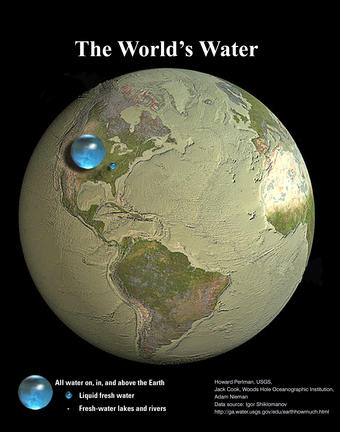
All Earth’s water, liquid fresh water, and water in lakes and rivers

All water on Earth in a sphere, placed over a

Spheres showing:


(
1)All water (largest sphere over western U.S., 860 miles (1,385 kilometers) in diameter)
(2) Fresh liquid water in the ground, lakes, swamps, and rivers (mid-sized sphere over Kentucky, 169.5 miles (272.8 kilometers) in diameter), and
(3) Fresh-water lakes and rivers (smallest sphere over Georgia, 34.9 miles i(56.2 kilometers) n diameter).

Credit: Howard Perlman, USGS; globe illustration by Jack Cook, Woods Hole Oceanographic Institution (©); and Adam Nieman.

The Earth is a watery place. But just how much water exists on, in, and above our planet? About 71 percent of the Earth’s surface is water-covered, and the oceans hold about 96.5 percent of all Earth’s water. Water also exists in the air as water vapor, in rivers and lakes, in icecaps and glaciers, in the ground as soil moisture and in aquifers, and even in you and your dog.

Water is never sitting still. Thanks to the water cycle, our planet’s water supply is constantly moving from one place to another and from one form to another. Things would get pretty stale without the water cycle!

All Earth’s water in a bubble

The globe illustration shows blue spheres representing relative amounts of Earth’s water in comparison to the size of the Earth. Are you surprised that these water spheres look so small? They are only small in relation to the size of the Earth. This image attempts to show three dimensions, so each sphere represents “volume.” The volume of the largest sphere, representing all water on, in, and above the Earth, would be about 332,500,000 cubic miles (mi3) (1,386,000,000 cubic kilometers (km3)), and be about 860 miles (about 1,385 kilometers) in diameter.

how many percent of salt water in earth

The smaller sphere

The smaller sphere over Kentucky represents Earth’s liquid fresh water in groundwater, swamp water, rivers, and lakes. The volume of this sphere would be about 2,551,000 mi3(10,633,450 km3) and form a sphere about 169.5 miles (272.8 kilometers) in diameter. Yes, all of this water is fresh water, which we all need every day, but much of it is deep in the ground, unavailable to humans.

Water is on and in the Earth

The vast majority of water on the Earth’s surface, over 96 percent, is saline water in the oceans. The freshwater resources, such as water falling from the skies and moving into streams, rivers, lakes, and groundwater, provide people with the water they need every day to live.

Water sitting on the surface of the Earth is easy to visualize, and your view of the water cycle might be that rainfall fills up the rivers and lakes. But, the unseen water below our feet is critically important to life, also

. How do you account for the flow in rivers after weeks without rain?

In fact, how do you account for the water flowing down a driveway on a day when it didn’t rain? The answer is that there is more to our water supply than just surface water, there is also plenty of water beneath our feet.

Where is Earth’s water located?

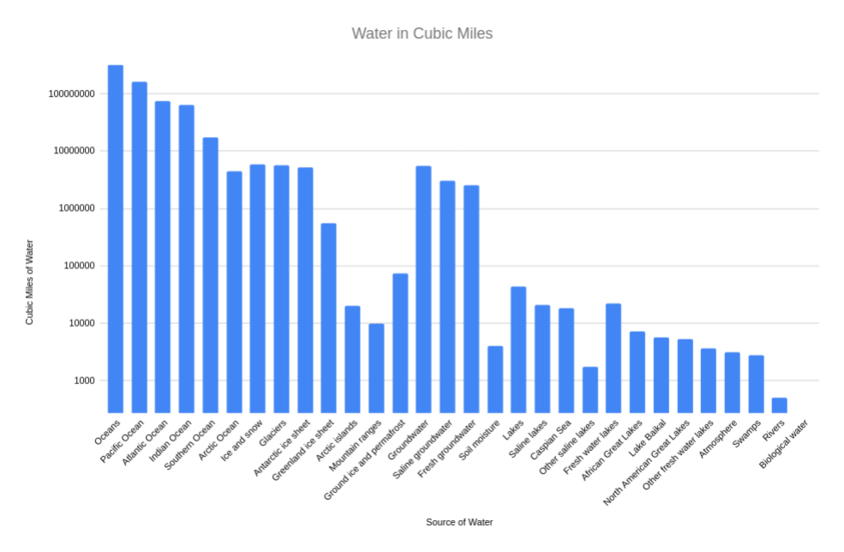
For a detailed explanation of where Earth’s water is, look at the data table below. Notice how of the world’s total water supply of about 332.5 million mi3 of water, over 96 percent is saline. Of total freshwater, over 68 percent is locked up in ice and glaciers. Another 30 percent of freshwater is in the ground. Rivers are the source of most of the fresh surface water people use, but they only constitute about 509 mi3 (2,120 km3), about 1/10,000th of one percent of total water.
Note: Percentages may not sum to 100 percent due to rounding.

how many percent of salt water in earth

Earth’s surface

Even though you may only notice water on the Earth’s surface, there is much more freshwater stored in the ground than there is in liquid form on the surface. In fact, some of the water you see flowing in rivers comes from seepage of groundwater into river beds. Water from precipitation continually seeps into the ground to recharge aquifers, while at the same time water in the ground continually recharges rivers through seepage.

what percentage of earth’s water is stored in oceans

۳۵۹ بازديد

what percentage of earth’s water is stored in oceans

Hello dear friends, thank you for choosing us. In this post on the solsarin site, we will talk about “what percentage of earth’s water is stored in oceans “.
Stay with us.
Thank you for your choice.

what percentage of earth's water is stored in oceans
what percentage of earth’s water is stored in oceans

Where is Earth’s Water?

Water, Water, Everywhere….”
You’ve heard the phrase, and for water, it really is true. Earth’s water is (almost) everywhere: above the Earth in the air and clouds, on the surface of the Earth in riversoceansiceplants, in living organisms, and inside the Earth in the top few miles of the ground.

water cycle

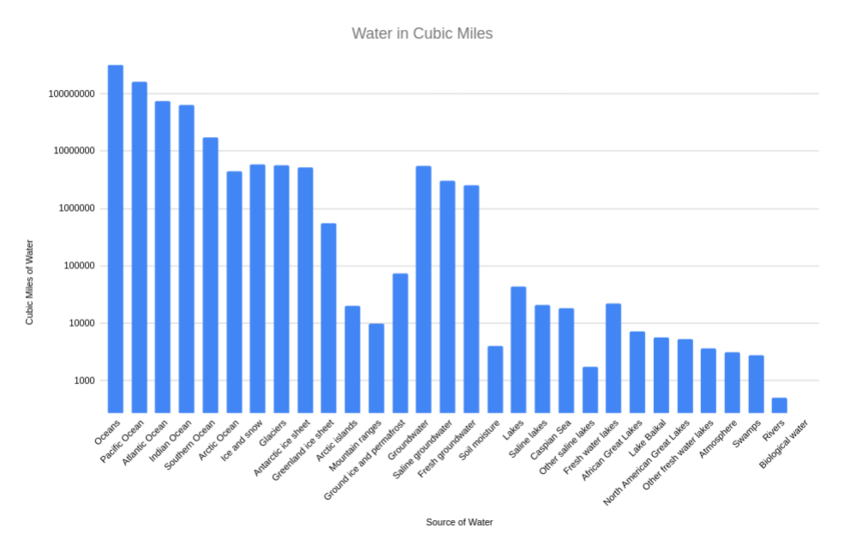
For an estimated explanation of where Earth’s water exists, look at this bar chart. You may know that the water cycle describes the movement of Earth’s water, so realize that the chart and table below represent the presence of Earth’s water at a single point in time. If you check back in a million years, no doubt these numbers will be different!

  • Left bar: All water, freshwater and saline, on, in, and above the Earth.
  • Center bar: All freshwater
  • Right bar: Only the portion of freshwater residing in surface water (rivers and lakes, etc), snow and ice, and relatively-shallow ground water.

Here is a bar chart showing where all water on, in, and above the Earth exists. The left-side bar chart shows how almost all of Earth’s water is saline and is found in the oceans. Of the small amount that is actually freshwater, only a relatively small portion is available to sustain human, plant, and animal life.

Where is all of the Earth’s water?

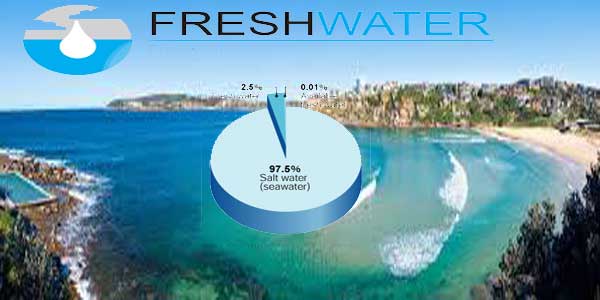
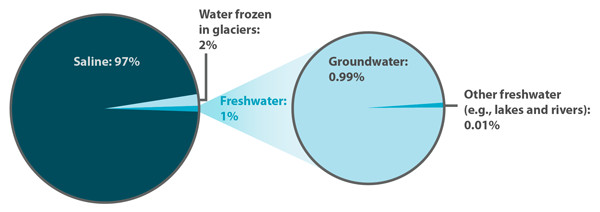
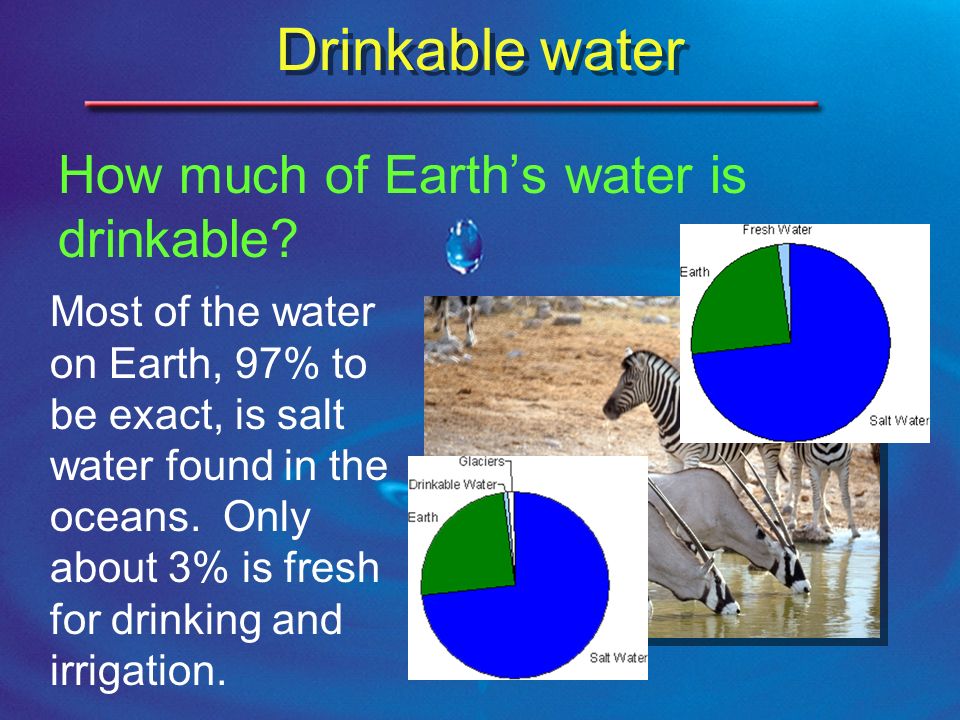
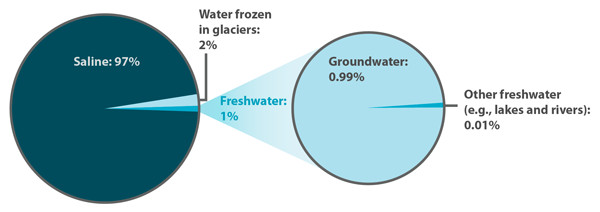
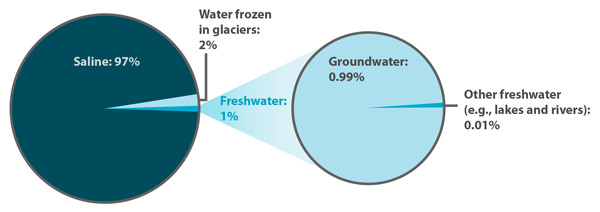
The ocean holds about 97 percent of the Earth’s water; the remaining three percent is distributed in many different places, including glaciers and ice, below the ground, in rivers and lakes, and in the atmosphere.

According to the U.S. Geological Survey, there are over 332,519,000 cubic miles of water on the planet. A cubic mile is the volume of a cube measuring one mile on each side. Of this vast volume of water, NOAA’s National Geophysical Data Center estimates that 321,003,271 cubic miles is in the ocean.

what percentage of earth's water is stored in oceans
what percentage of earth’s water is stored in oceans

Distribution of Earth’s Water

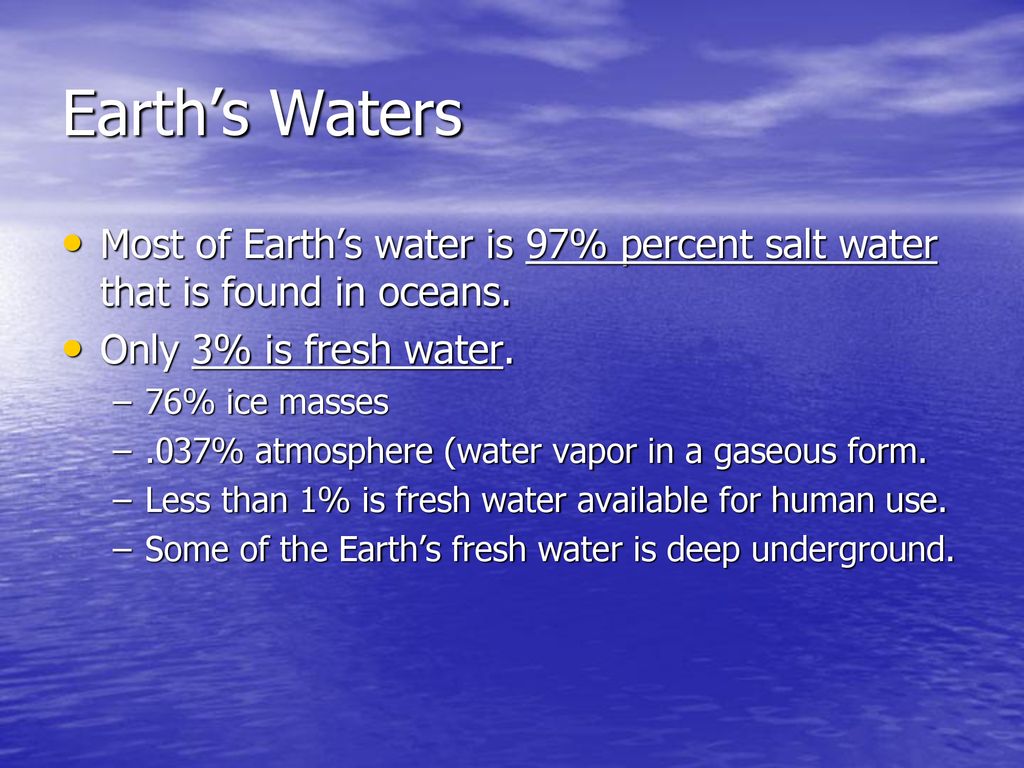
Earth’s oceans contain 97% of the planet’s water, so just 3% is fresh water, water with low concentrations of salts. Most fresh water is trapped as ice in the vast glaciers and ice sheets of Greenland.

A storage location for water such as an ocean, glacier, pond, or even the atmosphere is known as a reservoir. A water molecule may pass through a reservoir very quickly or may remain for much longer.

The amount of time

The amount of time a molecule stays in a reservoir is known as its residence time.Earth’s oceans contain 97% of the planet’s water, so just 3% is fresh water, water with low concentrations of salts.

Most fresh water is trapped as ice in the vast glaciers and ice sheets of Greenland. A storage location for water such as an ocean, glacier, pond, or even the atmosphere is known as a reservoir.

A water molecule may pass through a reservoir very quickly or may remain for much longer. The amount of time a molecule stays in a reservoir is known as its residence time.

Three States of Water

Because of the unique properties of water, water molecules can cycle through almost anywhere on Earth. The water molecule found in your glass of water today could have erupted from a volcano early in Earth history.

In the intervening billions of years, the molecule probably spent time in a glacier or far below the ground. The molecule surely was high up in the atmosphere and maybe deep in the belly of a dinosaur.

Where will that water molecule go next?

Water is the only substance on Earth that is present in all three states of matter – as a solid, liquid or gas.

Along with that, Earth is the only planet where water is present in all three states.

Because of the ranges in temperature in specific locations around the planet, all three phases may be present in a single location or in a region. The three phases are solid (ice or snow), liquid (water), and gas (water vapor).

what percentage of earth's water is stored in oceans
what percentage of earth’s water is stored in oceans

The Water Cycle

Because Earth’s water is present in all three states, it can get into a variety of environments around the planet. The movement of water around Earth’s surface is the hydrologic (water) cycle.

The Sun, many millions of kilometers away, provides the energy that drives the water cycle. Our nearest star directly impacts the water cycle by supplying the energy needed for evaporation.

Most of Earth’s water is stored in the oceans where it can remain for hundreds or thousands of years. The oceans are discussed in detail in the chapter Earth’s Oceans.

Water changes what?

Water changes from a liquid to a gas by evaporation to become water vapor. The Sun’s energy can evaporate water from the ocean surface or from lakes, streams, or puddles on land. Only the water molecules evaporate; the salts remain in the ocean or a freshwater reservoir.

The water vapor remains in the atmosphere until it undergoes condensation to become tiny droplets of liquid. The droplets gather in clouds, which are blown about the globe by wind.

As the water droplets in the clouds collide and grow, they fall from the sky as precipitation. Precipitation can be rain, sleet, hail, or snow. Sometimes precipitation falls back into the ocean and sometimes it falls onto the land surface.

how to treat dog wounds from fighting

۳۸۲ بازديد

how to treat dog wounds from fighting

Hello dear friends, thank you for choosing us. In this post on the solsarin site, we will talk about “how to treat dog wounds from fighting “.
Stay with us.
Thank you for your choice.

Home Care for Dog Wound

If your dog has been fighting with another animal, look your dog over carefully for wounds. If a wound is visible and bleeding, apply a clean cloth to the wound or wrap it around the wound for added pressure to control the bleeding. Some parts of the body are more vascular than other regions.

Wound Care

To clean the wounds at home, you can apply a small amount of petroleum jelly on the wound and clip the fur around the bites. Petroleum jelly will help to keep hair out of the injury and prevent bacteria located on your dog’s fur out of the wound. Once the wound is visible and free of the obstacles or fur, clean it thoroughly with a betadine, iodine, or hydrogen peroxide solution. Whether you are continuing veterinary care or cleaning minor wounds from home, you will need to continue to keep the wound clean with hydrogen peroxide and a gentle gauze several times a day. Applying antibiotic ointment will help keep infection away, keep the wound clean and free of bacteria, as well as help with healing.
how to treat dog wounds from fighting

Infection

If, for any reason, you think your dog has an infection, or if a known infection has worsened, contact your veterinarian for an exam or recheck and antibiotics.

Three basic

Three basic signs of infection in your dog will be swelling, discharge, and redness. Restricting exercise and keeping your dog resting and relaxed while all bite wounds heal is crucial. Your dog’s skin will need time to heal without risk of reopening the wounds.
If your veterinarian installed a drain, you will want to keep the area around the drain clean and clear of any pus discharge.
Drains can usually be removed after three to five days. After the drain is removed, you will need to follow up at home with hydrogen peroxide and gauze cleaning and home care for several days as the bite wounds heal.

Dog fights

Dog fights happen, even to the best of dogs and with the most responsible of owners.
Whether your dog is on a leash, roaming free, or at a dog park, other dogs biting your dog is not only possible but a common reason for pet owners to bring their dogs to their veterinarian for an emergency visit.
Even animals within your own home could inflict a bite wound on your dog.
If your dog has been involved in a fight with an animal you do not know or another dog, you may want to visit with

veterinarian

your veterinarian and be sure the other animal is tested for rabies, if possible. In the least, your veterinarian may want to administer antibiotics to fight any infection from the offending animal’s mouth and pain medications to assist with pain.
Assessment Some bite injuries are not incredibly apparent. If your dog has been fighting with another animal, look your dog over carefully for wounds.
If a wound is visible and bleeding, apply a clean cloth to the wound or wrap it around the wound for added pressure to control the bleeding. Some parts of the body are more vascular than other regions.

Head wounds

Head wounds will bleed more profusely than leg or trunk lacerations. Once you have control over your dog and have done a quick initial assessment,
you will need to decide if your dog needs emergency care right away or if you can wait for your veterinarian to fit you in with an appointment.
Wound Care To clean the wounds at home, you can apply a small amount of petroleum jelly on the wound and clip the fur around the bites.
how to treat dog wounds from fighting

Petroleum jelly

Petroleum jelly will help to keep hair out of the injury and prevent bacteria located on your dog’s fur out of the wound.
Once the wound is visible and free of the obstacles or fur, clean it thoroughly with a betadine, iodine,
or hydrogen peroxide solution.
Whether you are continuing veterinary care or cleaning minor wounds from home
, you will need to continue to keep the wound clean with hydrogen peroxide and a gentle gauze several times a day.

antibiotic

Applying antibiotic ointment will help keep infection away, keep the wound clean and free of bacteria, as well as help with healing. Infection If, for any reason, you think your dog has an infection,
or if a known infection has worsened, contact your veterinarian for an exam or recheck and antibiotics.
Three basic signs of infection in your dog will be swelling, discharge, and redness. Restricting exercise and keeping your dog resting and relaxed while all bite wounds heal is crucial.
Your dog’s skin will need time to heal without risk of reopening the wounds.

If your veterinarian

If your veterinarian installed a drain, you will want to keep the area around the drain clean and clear of any pus discharge.
Drains can usually be removed after three to five days.

The absolute best prevention

The absolute best prevention for bite wounds is to keep control over your dog and know your surroundings when you are out with your pup.
If you are in a public area with other dogs around,
keep your dog on a tight leash and within your control.
Don’t let your dog roam freely outside around your house or with you on running trails or public areas. Dog training classes are helpful for teaching your dog obedience.
However, not all dogs will be as well behaved as your dog might be.

Though some dog

you can do your part as a responsible dog owner by following the rules of common sense when you are out in public with your dog or around your home and neighborhood.

how to calculate percentage of water in hydrated salt

۳۹۵ بازديد

how to calculate percentage of water in hydrated salt

Hello dear friends, thank you for choosing us. In this post on the solsarin site, we will talk about “ how to calculate percentage of water in hydrated salt “.
Stay with us.
Thank you for your choice.

how to calculate percentage of water in hydrated salt

How can I calculate the percent composition of water in a hydrate?

This is a classic chem lab! It involves massing a compound, then heating it to remove water and then measuring its mass a second time.

Explanation:

how to calculate percentage of water in hydrated salt

This can be approached in two different ways, calculating the percent of water in a hydrate from experimental data or analysis of a chemical formula.

Let’s discuss experimental analysis first. Let’s say that you are given a hydrated salt we’ll call Y. Its general formula would be…

Y•X(H2O).

calculate the percent of water

If you heat the sample you will be able to dry it and remove all of the water leaving just Y. To calculate the percent of water you will divide the change in mass of your sample (mass of water removed) by the mass of the hydrated salt (original mass).

If you are given the formula you would do analysis of the information provided…

CuSO4 = 159.62g
Mass of water = 18.02 x 5 = 90.1g
CuSO4•5(H2O) = 249.72g

% water = (90.1 / 249.72) x 100 = 36.08%

Presentation on theme: “Determining the Percent of Water in a Hydrated Salt Questions and Calculations Help.”— Presentation transcript:

Determining the Percent of Water in a Hydrated Salt Questions and Calculations Help

Calculation

#1a Use the % composition equation from your reference tables to solve this problem. Use the % composition equation from your reference tables to solve this problem. Mass of water = part Mass of water = part Mass of hydrated salt = whole Mass of hydrated salt = whole

Calculation

#1b Use the % composition equation from your reference tables to solve this problem. Use the % composition equation from your reference tables to solve this problem. Mass of anhydrous salt = part Mass of anhydrous salt = part Mass of

hydrated salt = whole Mass of hydrated salt = whole

how to calculate percentage of water in hydrated salt

Calculation

#2 a&b This question references the first question. If you had 100 grams of sample, use your percentages from #1 to determine grams of water and anhydrous salt would be present. See next slide… This question references the first question. If you had 100 grams of sample, use your percentages from #1 to determine grams of water and anhydrous salt would be present. See next slide…

Calculation

#2 a&b For example: For example: If you calculated 25% water and 75% anhydrous, then 25 grams would be water and 75 grams would be anhydrous salt. If you calculated 25% water and 75% anhydrous, then 25 grams would be water and 75 grams would be anhydrous salt.

Calculation

#3 Change grams of water (driven off) to moles of water. Change grams of water (driven off) to moles of water. Grams water moles water Grams water moles water Use “Mole Triangle” if necessary Use “Mole Triangle” if necessary

Calculation

4a Do the following calculation for your unknown only!!!! Do the following calculation for your unknown only!!!! Use the masses from the Periodic Table to determine the total mass for your unknown. (See #35 in your Unit VI note packet for additional help) Use the masses from the Periodic Table to determine the total mass for your unknown. (See #35 in your Unit VI note packet for additional help).

Calculation 4b Use the formula mass you just calculated to convert the mass of your anhydrous salt (from your data table) to moles. Use the formula mass you just calculated to convert the mass of your anhydrous salt (from your data table) to moles. Grams anhydrousmoles Grams anhydrousmoles Use “Mole Triangle” if needed. Use “Mole Triangle” if needed.

Calculation

5 Use the moles you calculated in #3 and #4b to determine the smallest whole number ratio. Use the moles you calculated in #3 and #4b to determine the smallest whole number ratio. Divide the larger # by the smaller #. Round the answer to a whole number. Divide the larger # by the smaller #. Round the answer to a whole number. This will give you “X” in the formula. Please re-write the formula and replace “X” with the # you just calculated. This will give you “X” in the formula. Please re-write the formula and replace “X” with the # you just calculated

What if there was water in the crucible when you started? Would this make you percent of water change?

(Increase, Decrease, or remain the same?) What if there was water in the crucible when you started? Would this make you percent of water change? (Increase, Decrease, or remain the same?)

11 Question 7

In this lab we re-heated the crucible & cover a second time to make sure the mass did not change. In this lab we re-heated the crucible & cover a second time to make sure the mass did not change. How might your percentage be affected if we had just heated once and assumed we removed all the water? How might your percentage be affected if we had just heated once and assumed we removed all the water?

12 Question 8

Inert material = material that does not react. Inert material = material that does not react. How would your % of water be affected if material was in the crucible when you began and remained there for the entire lab? How would your % of water be affected if material was in the crucible when you began and remained there for the entire lab?

13 Question 9 & 10

See your Unit VI notes (Pages 21-24) for help with these two questions. See your Unit VI notes (Pages 21-24) for help with these two questions. #9 – You are calculating an empirical formula. #9 – You are calculating an empirical formula. #10 – You are calculating a molecular formula. #10 – You are calculating a molecular formula.

what percentage of water on earth is available for human use

۳۸۳ بازديد

what percentage of water on earth is available for human use

Hello dear friends, thank you for choosing us. In this post on the solsarin site, we will talk about “  what percentage of water on earth is available for human use“.
Stay with us.
Thank you for your choice.

A Clean Water Crisis

The water you drink today has likely been around in one form or another since dinosaurs roamed the Earth, hundreds of millions of years ago.

While the amount of freshwater on the planet has remained fairly constant over time—continually recycled through the atmosphere and back into our cups—the population has exploded. This means that every year competition for a clean, copious supply of water for drinking, cooking, bathing, and sustaining life intensifies.

Water scarcity is an abstract concept to many and a stark reality for others. It is the result of myriad environmental, political, economic, and social forces.

what percentage of water on earth is available for human use

Freshwater

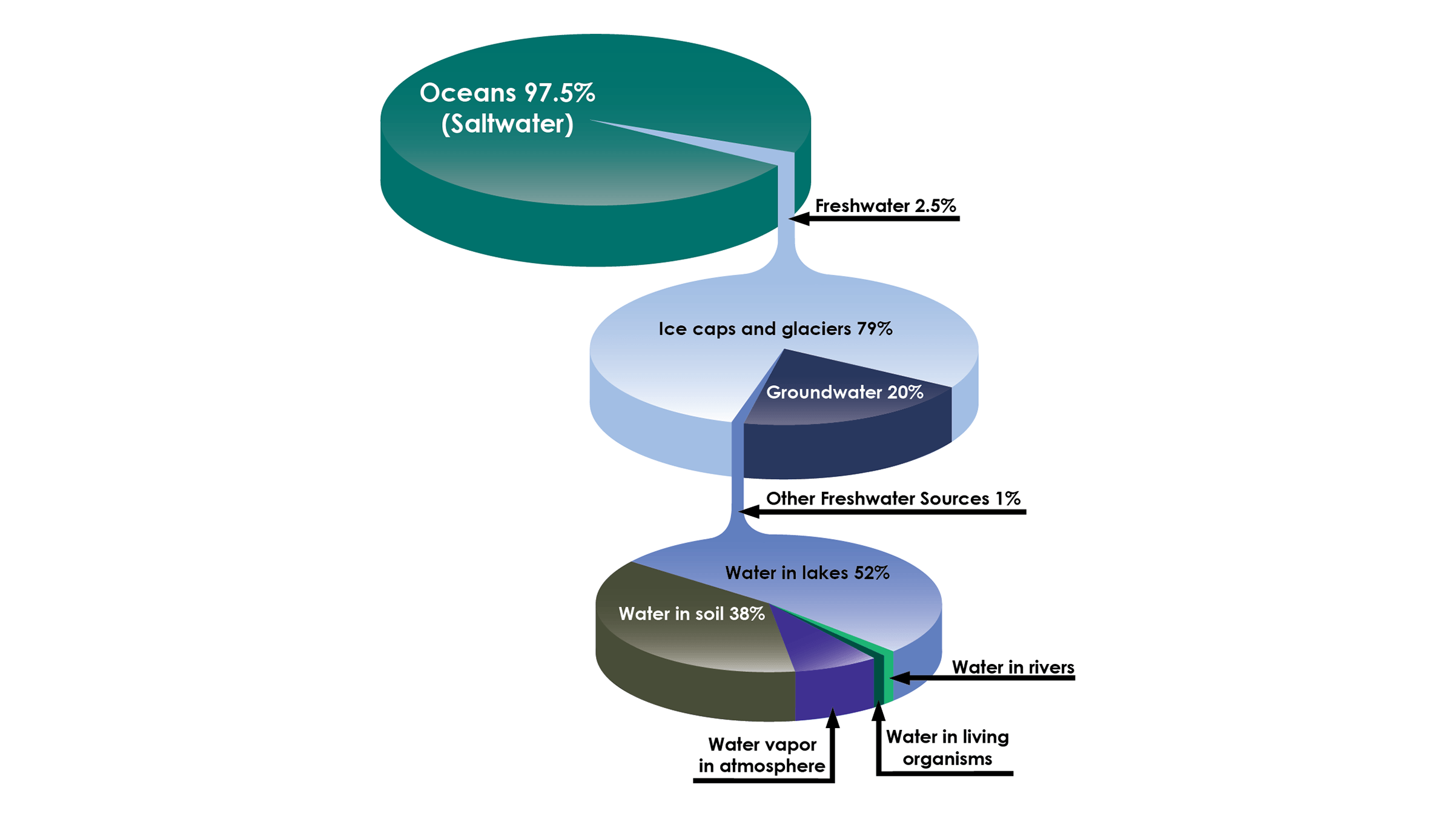
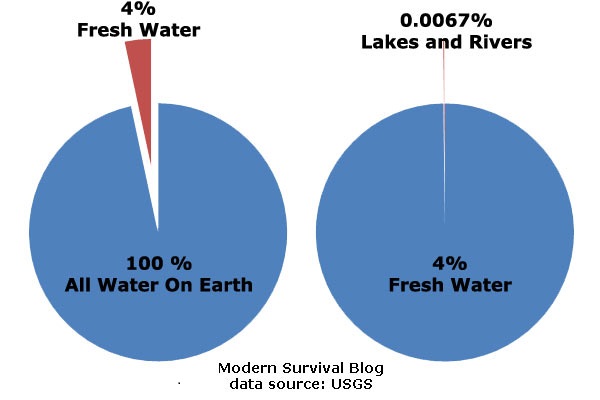
Freshwater makes up a very small fraction of all water on the planet. While nearly 70 percent of the world is covered by water, only 2.5 percent of it is fresh. The rest is saline and ocean-based. Even then, just 1 percent of our freshwater is easily accessible, with much of it trapped in glaciers and snowfields. In essence, only 0.007 percent of the planet’s water is available to fuel and feed its 6.8 billion people.

Due to geography, climate, engineering, regulation, and competition for resources, some regions seem relatively flush with freshwater, while others face drought and debilitating pollution. In much of the developing world, clean water is either hard to come by or a commodity that requires laborious work or significant currency to obtain.

Water Is Life

Wherever they are, people need water to survive. Not only is the human body 60 percent water, the resource is also essential for producing food, clothing, and computers, moving our waste stream, and keeping us and the environment healthy.

What is the Percentage of Drinkable Water on Earth?


With merely 5% of the ocean floor having been discovered and mapped, and with the deepest part reaching almost 7 miles, water seems to be as abundant as it is ominous.

Yet, it wouldn’t take much of the mineral-rich ocean to dehydrate a human being if consumed. The amount of sodium in seawater is much more concentrated than what the body can safely process, requiring more water as salt is consumed. Eventually, death would come as a result of dehydration without ever having the thirst quenched (Ocean Service).

Of the waters occupying 70%

Of the waters occupying 70% of the earth’s surface, only 3% is considered freshwater. And most of this freshwater reserve is inaccessible to humans — locked up in polar ice caps or stored too far underneath the earth’s surface to be extracted. Furthermore, much of the freshwater that is accessible has become highly polluted.

This leaves us with roughly 0.4% of the earth’s water which is usable and drinkable to be shared among the 7 billion of its inhabitants (World Atlas, 2018).

Surface Water

Surface water is any body of water that is on the earth’s surface: lakes, rivers, streams, and reservoirs. 80% of the world’s daily water usage comes from surface water and makes up the majority of the water used for irrigation and public supply. Oceans are the world’s largest source of surface water and make up 97% of it, but due to its high salinity, it is unusable for humans (Postel, 2010).

The earth’s surface waters

The earth’s surface waters travel through a complex network of flowing rivers and streams. Rivers can obtain their water from two sources: base flow and runoff. Base flow is when the river collects its water from water-saturated areas in the ground, adding to its volume. Runoff is when the force of gravity naturally pulls water downhill from higher to lower altitudes. They usually start as small creeks in the mountains, and then gradually merge with larger streams as they flow downward, eventually forming large rivers which empty out into the ocean.

Groundwater

Groundwater is the water beneath the earth’s surface that is at 100% saturation. Anything less than 100% is considered soil mixture. 98% of the earth’s freshwater is indeed groundwater and it is about 60 times more plentiful than the surface water.
Groundwater travels through holes and cracks in the bedrock.
what percentage of water on earth is available for human use

The Hydrologic Cycle

 When water evaporates, liquid molecules become gas molecules as they rise through the atmosphere. Condensation begins when the moisture from these gas molecules becomes so great that they fall back to earth in the form of precipitation.
They are the storehouses for the world’s freshwater.

Water Conflicts Around the World

There are 263 rivers and countless aquifers worldwide which either cross or demarcate geopolitical boundaries. The Atlas of International Freshwater Agreement states that 90 percent of the world’s countries share these water sources with at least one or two other governing bodies. The atrocities in Darfur are an example of conflict resulting from clean water shortages.

• Violence erupts in 1992 over a dispute between Uzbekistan and Turkmenistan regarding the contested Tyuyamuyun reservoir.

what percent of earth’s freshwater is surface water available for human use

۳۷۰ بازديد

what percent of earth’s freshwater is surface water available for human use

Hello dear friends, thank you for choosing us. In this post on the solsarin site, we will talk about “ what percent of earth’s freshwater is surface water available for human use“.
Stay with us.
Thank you for your choice.

what percent of earth's freshwater is surface water available for human use
what percent of earth’s freshwater is surface water available for human use

Distribution of the Earth’s water

Earth is known as the “Blue Planet” because 71 percent of the Earth’s surface is covered with water. Water also exists below land surface and as water vapor in the air. Water is a finite source. The bottled water that is consumed today might possibly be the same water that once trickled down the back of a wooly mammoth. The Earth is a closed system, meaning that very little matter, including water, ever leaves or enters the atmosphere; the water that was here billions of years ago is still here now. But, the Earth cleans and replenishes the water supply through the hydrologic cycle.

The earth has an abundance of water, but unfortunately, only a small percentage (about 0.3 percent), is even usable by humans. The other 99.7 percent is in the oceans, soils, icecaps, and floating in the atmosphere. Still, much of the 0.3 percent that is useable is unattainable. Most of the water used by humans comes from rivers. The visible bodies of water are referred to as surface water. The majority of fresh water is actually found underground as soil moisture and in aquifers. Groundwater can feed the streams, which is why a river can keep flowing even when there has been no precipitation. Humans can use both ground and surface water.

Distribution of the water on Earth

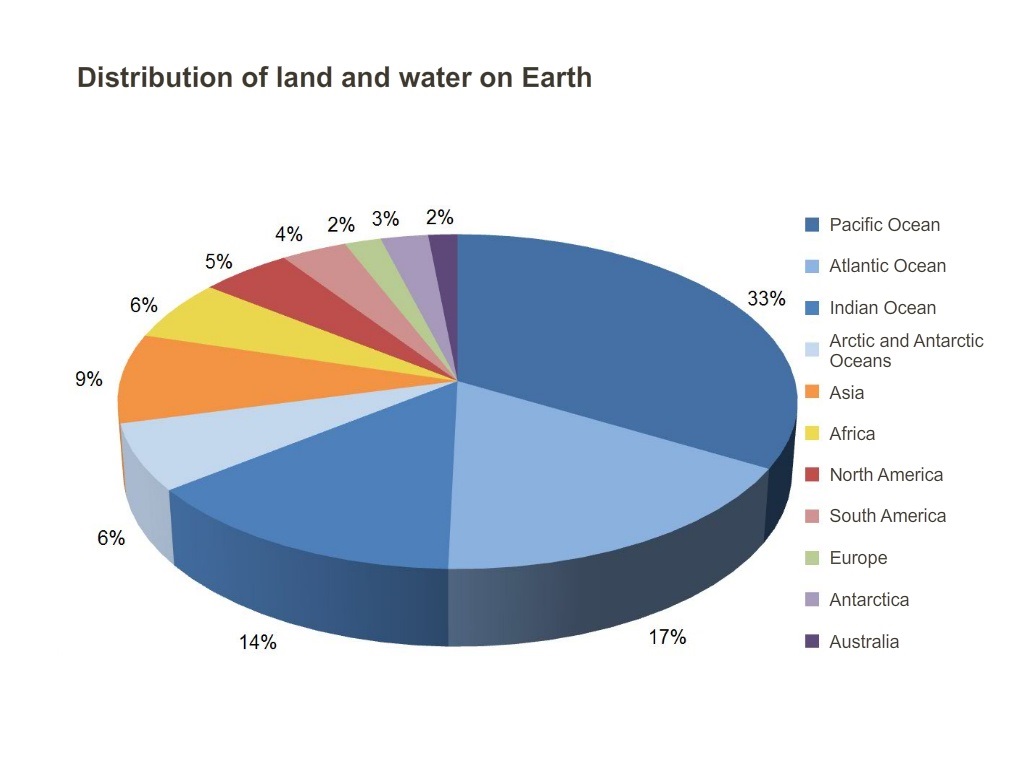
  • Ocean water: 97.2 percent
  • Glaciers and other ice: 2.15 percent
  • Groundwater,: 0.61 percent
  • Fresh water lakes: 0.009 percent
  • Inland seas: 0.008 percent
  • Soil Moisture: 0.005 percent
  • Atmosphere: 0.001 percent
  • Rivers: 0.0001 percent.

Surface water

Surface water is far easier to reach, so this becomes the most common source of potable water. About 321 billion gallons per day of surface water is used by humans.

Surface waters can…

Surface waters can be simply described as the water that is on the surface of the Earth. This includes the oceans, rivers and streams, lakes, and reservoirs. Surface waters are very important. They constitute approximately 80 percent of the water used on a daily basis.

In 1990, the United States alone used approximately 327,000 billion gallons of surface water a day. Surface waters make up the majority of the water used for public supply and irrigation.

It plays less of a role in mining and livestock industries. Oceans, which are the largest source of surface water, comprise approximately 97 percent of the Earth’s surface water. However, since the oceans have high salinity, the water is not useful as drinking water.

Efforts

The oceans also play a vital role in the hydrologic cycle, in regulating the global climate, and in providing habitats for thousands of marine species.

Rivers and streams

Rivers and streams constitute the flowing surface waters. The force of gravity naturally draws water from a higher altitude to a lower altitude.

Rivers obtain their water from two sources: groundwater, and runoff.

This is known as base flow to the stream. Runoff flows downhill, first as small creeks, then gradually merging with other creeks and streams, increasing in size until a river has formed. These small creeks, or tributaries, where the river begins are known as the headwaters. Springs from confined aquifers also can contribute to rivers.

what percent of earth's freshwater is surface water available for human use
what percent of earth’s freshwater is surface water available for human use

The water cycle

The hydrologic cycle or water cycle is a graphic representation of how water is recycled through the environment. Water molecules remain constant, though they may change between solid, liquid, and gas forms. Drops of water in the ocean evaporate, which is the process of liquid water becoming water vapor.

Evaporation can occur from water surfaces, land surfaces, and snow fields into the air as water vapor. Moisture in the air can condensate, which is the process of water vapor in the air turning into liquid water. Water drops on the outside of a cold glass of water are condensed water.

Condensation is the opposite

Condensation is the opposite process of evaporation. Water vapor condenses on tiny particles of dust, smoke, and salt crystals to become part of a cloud. After a while, the water droplets combine with other droplets and fall to Earth in the form of precipitation (rain, snow, hail, sleet, dew, and frost).

Once the precipitation has fallen to Earth, it may go into an aquifer as groundwater or the drop may stay above ground as surface water. The hydrologic cycle is an important concept to understand.

Water

Water has so many uses on Earth, such as human and animal consumption, power production, and industrial and agricultural needs. Precipitation—in the form of rain and snow—also is an important thing to understand.

It is the main way that the water in the skies comes down to Earth, where it fills the lakes and rivers, recharges the underground aquifers, and provides drinks to plants and animals. Different amounts of precipitation fall on different areas of the Earth at different rates and at various times of the year.

what percentage of earth’s freshwater available for human use

۳۸۵ بازديد

what percentage of earth’s freshwater available for human use

Hello dear friends, thank you for choosing us. In this post on the solsarin site, we will talk about “  what percentage of earth’s water is freshwater that we can use“.
Stay with us.
Thank you for your choice.

what percentage of earth’s freshwater available for human use

Freshwater Availability

Water is the fundamental ingredient for life on Earth. You can find it in the atmosphere above us, in the ocean, rivers and lakes around us, and in the rocks below us. Of all of the water on Earth, 97% is saltwater, leaving a mere 3% as freshwater, approximately 1% of which is readily available for our use. The world’s population is becoming more and more reliant on this precious resource for power, irrigation, industrial practices, and daily consumption.

Sensors on a suite of NASA satellites

Sensors on a suite of NASA satellites observe and measure freshwater resources, including rainfall, snow and ice, rivers and lakes, groundwater, soil moisture, and water quality. These measurements are important to understanding the availability and distribution of Earth’s water, which is both vital to life and vulnerable to the impacts of climate change and a growing world population.

Freshwater Crisis

There is the same amount of freshwater on earth as there always has been, but the population has exploded, leaving the world’s water resources in crisis.

A Clean Water Crisis

The water you drink today has likely been around in one form or another since dinosaurs roamed the Earth, hundreds of millions of years ago.

While the amount of freshwater on the planet has remained fairly constant over time—continually recycled through the atmosphere and back into our cups—the population has exploded. This means that every year competition for a clean, copious supply of water for drinking, cooking, bathing, and sustaining life intensifies.

Water scarcity is an abstract concept to many and a stark reality for others. It is the result of myriad environmental, political, economic, and social forces.

Freshwater

Freshwater makes up a very small fraction of all water on the planet. While nearly 70 percent of the world is covered by water, only 2.5 percent of it is fresh. The rest is saline and ocean-based. Even then, just 1 percent of our freshwater is easily accessible, with much of it trapped in glaciers and snowfields. In essence, only 0.007 percent of the planet’s water is available to fuel and feed its 6.8 billion people.

 what percentage of earth’s freshwater available for human use
what percentage of earth’s freshwater available for human use

Due to geography, climate, engineering, regulation, and competition for resources, some regions seem relatively flush with freshwater, while others face drought and debilitating pollution. In much of the developing world, clean water is either hard to come by or a commodity that requires laborious work or significant currency to obtain.

Water Is Life

Wherever they are, people need water to survive. Not only is the human body 60 percent water, the resource is also essential for producing food, clothing, and computers, moving our waste stream, and keeping us and the environment healthy.

Where is Earth’s Water?

Water, Water, Everywhere….”
You’ve heard the phrase, and for water, it really is true. Earth’s water is (almost) everywhere: above the Earth in the air and clouds, on the surface of the Earth in riversoceansiceplants, in living organisms, and inside the Earth in the top few miles of the ground.

water cycle

For an estimated explanation of where Earth’s water exists, look at this bar chart. You may know that the water cycle describes the movement of Earth’s water, so realize that the chart and table below represent the presence of Earth’s water at a single point in time. If you check back in a million years, no doubt these numbers will be different!

  • Left bar: All water, freshwater and saline, on, in, and above the Earth.
  • Center bar: All freshwater
  • Right bar: Only the portion of freshwater residing in surface water (rivers and lakes, etc), snow and ice, and relatively-shallow ground water.

Here is a bar chart showing where all water on, in, and above the Earth exists. The left-side bar chart shows how almost all of Earth’s water is saline and is found in the oceans. Of the small amount that is actually freshwater, only a relatively small portion is available to sustain human, plant, and animal life.

Without water our planet

Without water our planet would be a barren wasteland. Of the three main ways in which people use water – municipal (drinking water and sewage treatment), industrial and agricultural (mostly irrigation) – farming accounts for the largest part, some 65 percent globally in 1 990.

Water is a finite resource: there are some 1 400 million cubic kilometres on earth and circulating through the hydrological cycle. Nearly all of this is salt water and most of the rest is frozen or under ground. Only one-hundredth of 1 percent of the world’s water is readily available for human use.

what percentage of earth’s freshwater available for human use

the population of developing countries

This would be enough to meet humanity’s needs – if it were evenly distributed. But it is not. In Malaysia 100 people share each million cubic metres of water; in India, the figure is 350 and in Israel, 4 000. And where there is water, it is often polluted: nearly a third of the population of developing countries has no access to safe drinking water.

the amount of water

In many countries, the amount of water available to each person is falling, as populations rise. By the year 2000, Latin America’s per caput water resources will have fallen by nearly three-quarters since 1950. In the twenty-first century the main constraint on development in Egypt will be access to water, not land. Over 230 million people live in countries – most of them in Africa or the Near East – where less than 1 000 cubic metres of water is available per person each year.

what percentage of earth’s water is freshwater that we can use

۳۸۲ بازديد

what percentage of earth’s water is freshwater that we can use

Hello dear friends, thank you for choosing us. In this post on the solsarin site, we will talk about “  what percentage of earth’s water is freshwater that we can use“.
Stay with us.
Thank you for your choice.

what percentage of earth's water is freshwater that we can use
what percentage of earth’s water is freshwater that we can use

Distribution of the Earth’s water

Earth is known as the “Blue Planet” because 71 percent of the Earth’s surface is covered with water. Water also exists below land surface and as water vapor in the air. Water is a finite source. The bottled water that is consumed today might possibly be the same water that once trickled down the back of a wooly mammoth. The Earth is a closed system, meaning that very little matter, including water, ever leaves or enters the atmosphere; the water that was here billions of years ago is still here now. But, the Earth cleans and replenishes the water supply through the hydrologic cycle.

The earth

The earth has an abundance of water, but unfortunately, only a small percentage (about 0.3 percent), is even usable by humans. The other 99.7 percent is in the oceans, soils, icecaps, and floating in the atmosphere. Still, much of the 0.3 percent that is useable is unattainable. Most of the water used by humans comes from rivers. The visible bodies of water are referred to as surface water. The majority of fresh water is actually found underground as soil moisture and in aquifers. Groundwater can feed the streams, which is why a river can keep flowing even when there has been no precipitation. Humans can use both ground and surface water.

Distribution of the water on Earth

  • Ocean water: 97.2 percent
  • Glaciers and other ice: 2.15 percent
  • Groundwater,: 0.61 percent
  • Fresh water lakes: 0.009 percent
  • Inland seas: 0.008 percent
  • Soil Moisture: 0.005 percent
  • Atmosphere: 0.001 percent
  • Rivers: 0.0001 percent.

Surface water

Surface water is far easier to reach, so this becomes the most common source of potable water. About 321 billion gallons per day of surface water is used by humans. About 77 billion gallons of groundwater are used each day. Problems also exist in contamination of the water supplies. This further limits the amount of water available for human consumption. Water is found in many different forms and in many different places. While the amounts of water that exist seem to be plentiful, the availability of the water for human consumption is limited.

Surface waters

Surface waters can be simply described as the water that is on the surface of the Earth. This includes the oceans, rivers and streams, lakes, and reservoirs. Surface waters are very important.

They constitute approximately 80 percent of the water used on a daily basis. In 1990, the United States alone used approximately 327,000 billion gallons of surface water a day. Surface waters make up the majority of the water used for public supply and irrigation. It plays less of a role in mining and livestock industries.

what percentage of earth's water is freshwater that we can use
what percentage of earth’s water is freshwater that we can use

Oceans

Oceans, which are the largest source of surface water, comprise approximately 97 percent of the Earth’s surface water. However, since the oceans have high salinity, the water is not useful as drinking water. Efforts have been made to remove the salt from the water (desalination), but this is a very costly endeavor. Salt water is used in the mining process, in industry, and in power generation. The oceans also play a vital role in the hydrologic cycle, in regulating the global climate, and in providing habitats for thousands of marine species.

Rivers and streams

Rivers and streams constitute the flowing surface waters. The force of gravity naturally draws water from a higher altitude to a lower altitude.

Rivers obtain their water from two sources: groundwater, and runoff. Rivers can obtain their water from the ground if they cut into the water table, the area in which the ground is saturated with water.

This is known as base flow to the stream. Runoff flows downhill, first as small creeks, then gradually merging with other creeks and streams, increasing in size until a river has formed. These small creeks, or tributaries, where the river begins are known as the headwaters. Springs from confined aquifers also can contribute to rivers.

A river

A river will eventually flow into an ocean. A river’s length can be difficult to determine, especially if it has numerous tributaries. The USGS Web site defines a river’s length as “the distance to the outflow point from the original headwaters where the name defines the complete length.” In order for water to flow, there must be land upgradient of the river, that is land that is at a higher elevation than the river.

The land that is upgradient of any point on the river is known as the drainage basin or watershed. Ridges of higher land, such as the Continental Divide, separate two drainage basins. Flowing water is extremely powerful and plays an important role in creating the landscape and in humans’ lives.

rivers carry soil

Rivers carry soil and sediment that have been washed into the river when it rains or snow melts. The faster the water moves, the larger the particle size the river is capable of carrying. The USGS measures how much sediment a river carries by measuring the streamflow, or the amount of water flowing past a given site; and the sediment concentration.

what percentage of earth's water is freshwater that we can use
what percentage of earth’s water is freshwater that we can use

Sediment in the river can be helpful and harmful. Sediment, when deposited on the banks and in the flood plain, makes excellent farmlands. However, sediment can harm and even destroy dams, reservoirs and the life in the stream.

The water cycle

Water molecules remain constant, though they may change between solid, liquid, and gas forms.

Drops of water in the ocean evaporate, which is the process of liquid water becoming water vapor. Evaporation can occur from water surfaces, land surfaces, and snow fields into the air as water vapor.

Moisture in the air can condensate, which is the process of water vapor in the air turning into liquid water. Water drops on the outside of a cold glass of water are condensed water.

Glaciers and ice caps

Glaciers and icecaps are referred to as storehouses for fresh water. They cover 10 percent of the world’s land mass. These glaciers are primarily located in Greenland and Antarctica. The glaciers in Greenland almost cover the entire land mass. Glaciers begin forming because of snowfall accumulation.

When snowfall exceeds the rate of melting in a certain area, glaciers begin to form.

This melting occurs in the summer. The weight of snow accumulating compresses the snow to form ice. Because these glaciers are so heavy, they can slowly move their way down hills.